Should I choose a split heat pump or a monoblock heat pump?
What’s the Difference?
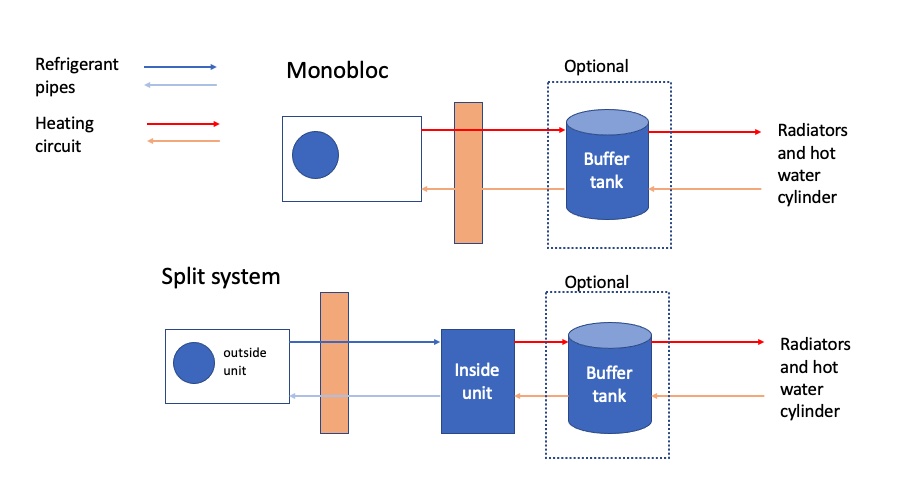
Monoblock Heat Pump: All components — compressor, condenser, pressure valve, etc. — are housed in a single outdoor unit. The indoor system connects to it via a sealed water circuit.
Split Heat Pump: Consists of two units: the compressor and condenser are placed outdoors, while the hydronic module — which includes elements like the expansion valve and heat exchanger — is located indoors. The two units are connected by refrigerant pipes.
Advantages and Disadvantages
Feature
Monoblock
Split System
Ease of Installation
Quick installation — only water pipes are needed; no F-Gas certification required
More complex — requires refrigerant piping and an F-Gas-certified technician
Maintenance
Single unit, easier access and servicing
Two units — more components to inspect and maintain
Freeze Protection in Cold Climates
Outdoor water pipes are at risk of freezing; glycol or antifreeze may be required
The entire water circuit is indoors, safer in very cold conditions
Efficiency and Energy Performance
Similar efficiency under comparable performance levels
Slight efficiency loss possible due to longer refrigerant lines
Indoor Space and Noise
No noise indoors, saves space
Indoor module generates noise and requires more space
Costs
Lower installation cost, simpler setup
Higher upfront cost, more complex installation
Which Option Is Recommended?
Monoblock: a practical solution for smaller budgets, simpler installations, retrofits, or when no F-Gas certified technician is available. Best suited for moderate climates with milder temperature variations.
Split System: recommended for colder climates or when greater flexibility is needed for indoor placement and system design. It can offer better overall performance but requires a higher initial investment.
https://virtualbau.hu/wp-content/uploads/2024/02/virtualbau_logo_color_RGB-300x112.png00tamas.fulekihttps://virtualbau.hu/wp-content/uploads/2024/02/virtualbau_logo_color_RGB-300x112.pngtamas.fuleki2025-08-07 07:44:462025-10-20 13:54:23Should I choose a split heat pump or a monoblock heat pump?